Arctic routes calculated for your ice class.
Enter the departure date and ice class. POLARROUTE AI computes the IMO POLARIS risk index (RIO) for every cell, avoids closed areas and finds the most efficient route at permitted speeds.
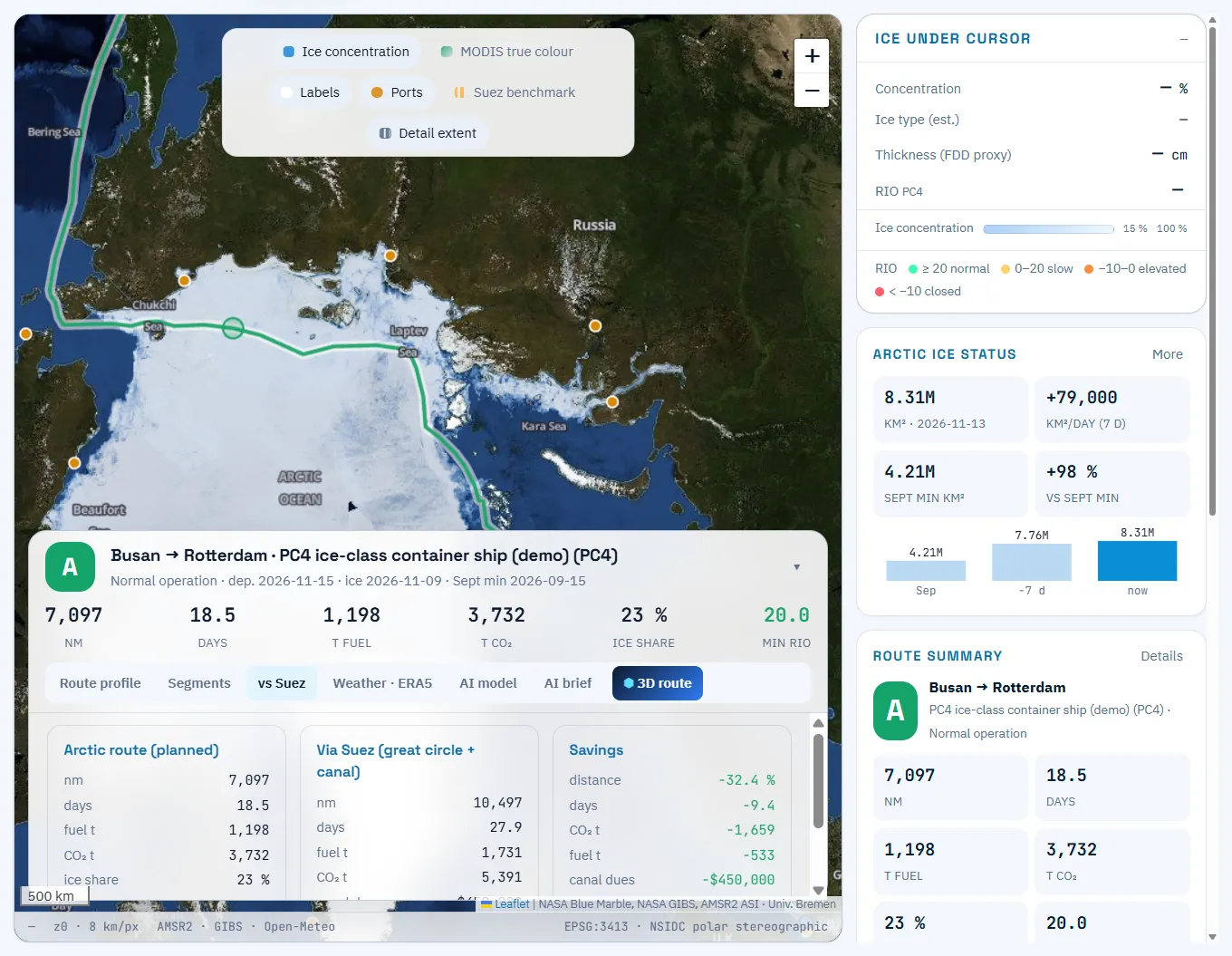
Inputs
Pick five things.
- Origin and destination (26 ports)
- Vessel and ice class (PC1–PC7, IA Super, IA, …)
- Departure date and ice-field date
- Safety weight (fastest ↔ avoid ice)
- Allow icebreaker escort (4 kn where RIO is −10 to 0)
POLARIS
How the risk index (RIO) is calculated.
We follow POLARIS, IMO’s methodology for assessing operational capability in polar ice.
C: concentration of each ice type (tenths) · RIV: risk index value for the ice class
| RIO | Meaning | Operation |
|---|---|---|
| 0 or above | Normal | Operate within design speed (the app flags 0–20 as “slow down”) |
| −10 to 0 | Elevated risk | PC1 11 kn, PC2 8 kn, PC3–5 5 kn; lower classes 4 kn under escort |
| Below −10 | Not permitted | Excluded from route search |
Optimal route
A* search: distance, speed and risk together.
No closed or land cells
Cells with RIO below −10 and land cells are never crossed (Natural Earth 50 m land mask).
16 directions
Moves in 16 directions on a 0.25°×0.5° grid to follow coastlines and ice edges.
Straits kept open
Key straits such as Vilkitsky, Kara Gate, Sannikov, Bering and Tsugaru are kept open despite grid size.
FAQ
Frequently asked questions
What is the safety weight?
At 0 the route is the fastest; higher values prefer lower-risk water even if longer. Tune it to your operations centre’s risk appetite.
What does allowing escort change?
Legs with RIO between −10 and 0 can be passed at 4 kn under icebreaker escort. Actual escort availability must be confirmed separately.
What does grade A mean?
An internal grade the app assigns from minimum RIO and ice share. It is not an official certification.
Get started
Try it on your own fleet’s voyages.
We walk you through the demo account and run your planned voyage on the latest ice field.